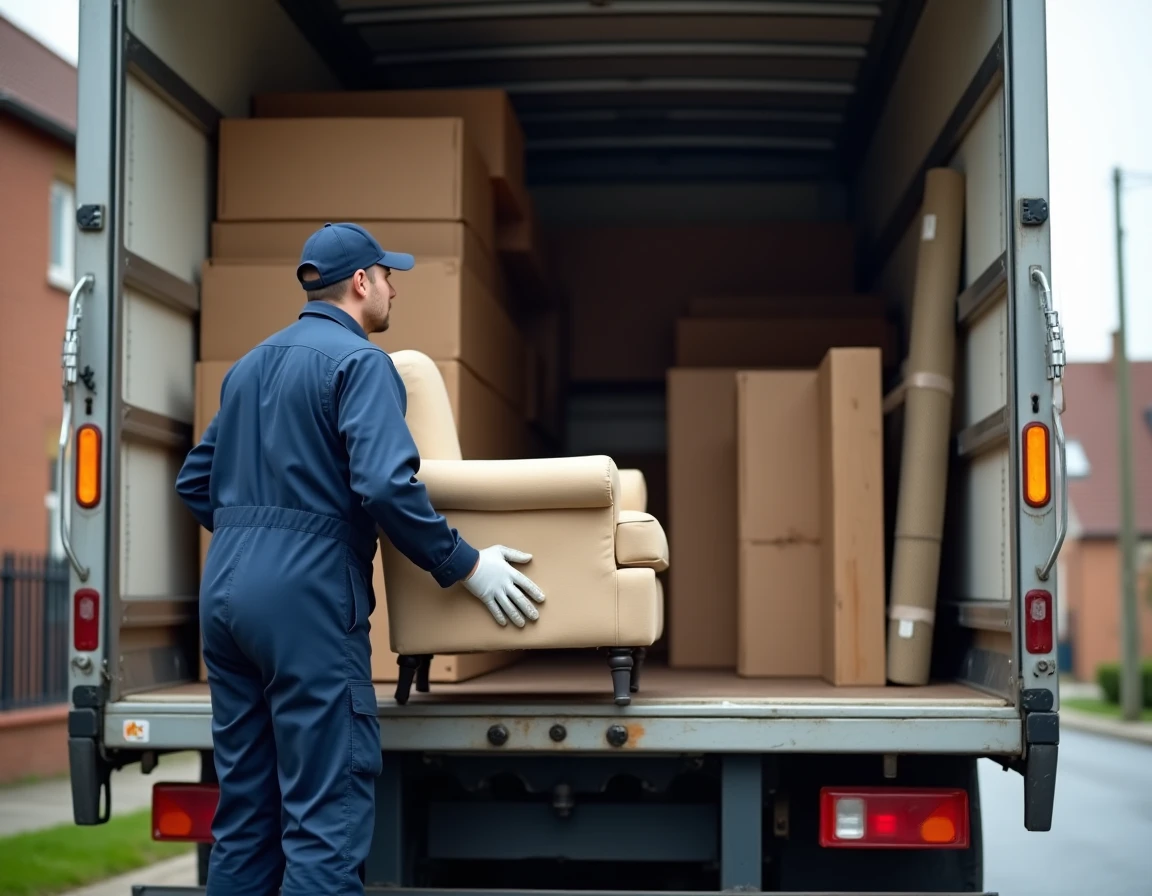
A three-seater sofa, a washing machine, twelve boxes of books, and a bicycle: this is the kind of load one prepares on a Saturday morning before wondering if everything will fit in the reserved truck. The volume of 16 m3 remains the most common format for moving between individuals, but its actual capacity depends as much on the shape of the objects as on the number of cubic meters advertised.
Weight constraint before volume constraint in a 16 m3 truck
We first think of volume, rarely of weight. On a 16 m3 van, the payload often caps around one ton, sometimes a little more depending on the model. Filling the floor space to the brim with boxes of books or dishes can exceed this limit long before all the available volume is occupied.
Distribution also matters. The Road Safety Delegation recommends placing the heaviest items in the center, close to the front axle, to avoid a pendulum effect when braking. Since the update of the European directive 2014/47/EU, checks on the securing of loads in light commercial vehicles have been strengthened. A poorly secured box that slides toward the tailgate can be enough to destabilize the vehicle during a sudden stop.
Before listing what we want to load, it is advisable to mentally weigh each category. If you want to know everything about the 16 m3 truck, the question of weight should be at the top of your preparation.
Moving a T2 or T3: what fits concretely
A typically furnished T2 apartment (double bed, sofa, table, four chairs, dresser, a few shelves, standard appliances) fits in a single trip in 16 m3. For a T3, it still works as long as bulky furniture is disassembled and boxes are stacked methodically.
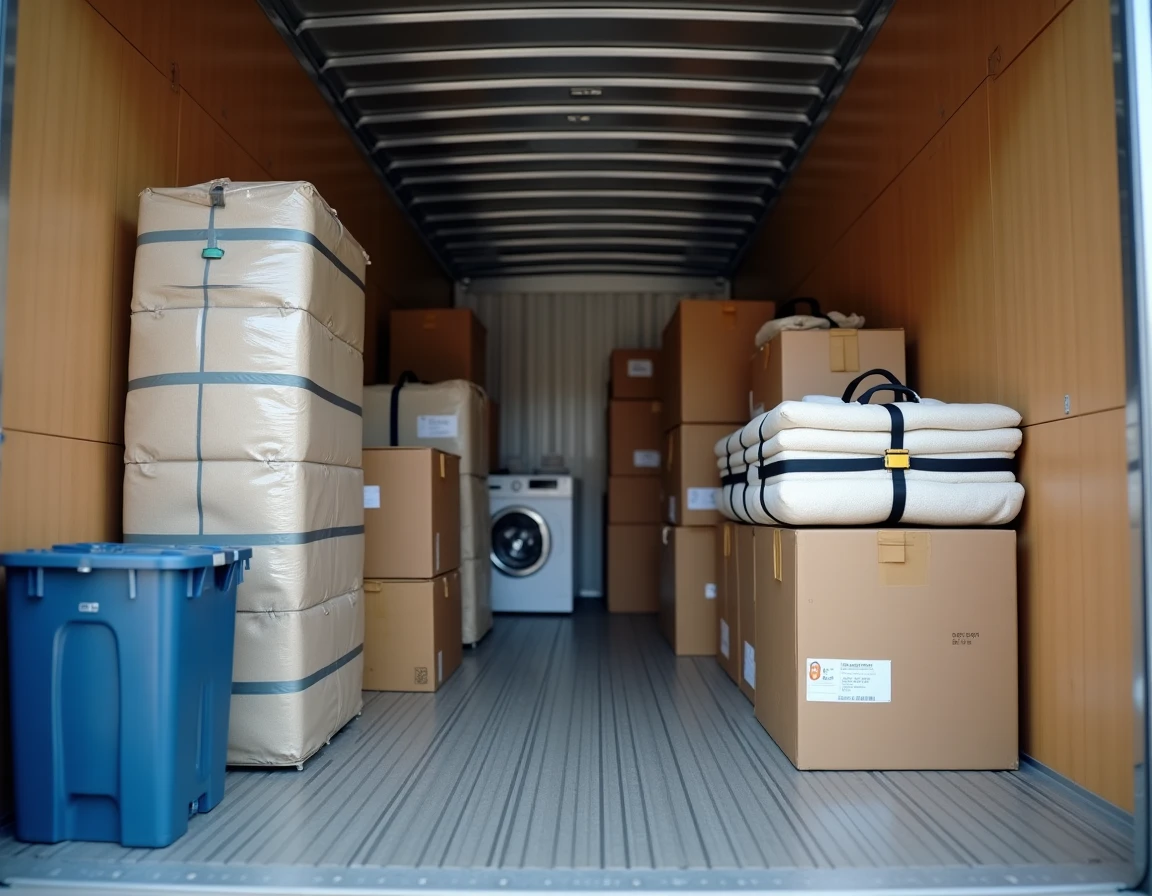
Here’s what is typically loaded into a 16 m3 for a home of this size:
- A two or three-seater sofa, a double bed with disassembled frame and mattress laid flat against a wall
- A washing machine, a standard refrigerator (not an American model), and possibly a dishwasher
- Between twenty and thirty standard-sized boxes, layered on flat furniture
- A disassembled table, stacked chairs, and small furniture (nightstands, shelves) slid into residual spaces
The mattress and sofa dictate the organization of the rest. They are placed first, standing along the side walls. The appliances go in next at the back, near the cab. The boxes fill the gaps. A bicycle can fit above the flat furniture if it is hung or secured properly.
Game-changing items
A vertical piano occupies little floor space but weighs between one hundred fifty and several hundred kilos depending on the model. It can consume a large part of the payload on its own. An empty aquarium, a non-disassemblable wardrobe, or an L-shaped corner sofa pose the same type of problem: their size takes up volume without allowing anything to be stacked on top.
When you have just one of these atypical items, the 16 m3 absorbs the rest without difficulty. Two or three pieces of this caliber require planning for a second trip or a larger vehicle.
Securing and loading: method to avoid breakage
Loading a van is not just about stacking. The most reliable method is to work in successive layers, from the back to the tailgate.
- First layer (cab side): heavy appliances, boxes of books and dishes, all secured against the front wall
- Second layer: disassembled furniture laid flat, mattress standing against the walls to serve as lateral protection
- Third layer (tailgate side): light boxes, wrapped fragile items, bags of clothes
- Ratchet straps tightened at least at two anchor points to secure everything in case of braking
Each layer must be stable before moving on to the next. A piece of furniture precariously balanced in the middle of the load always ends up falling, even on a twenty-minute trip.

Ratchet straps are not an optional accessory. Most rental companies provide them, but they can sometimes be worn out or insufficient in number. Bringing your own (two to four five-meter straps) avoids unpleasant surprises.
Low emission zones: check the Crit’Air before booking
In cities with low emission zones (ZFE-m) (Paris, Lyon, Marseille, Grenoble, among others), several municipal decrees published between 2022 and 2024 prohibit the circulation of diesel vans classified Crit’Air 4 and 5. An older 16 m3 truck rented from a small local provider may very well fall into this category.
Check the Crit’Air sticker of the vehicle at the time of booking, not on the day of the move. Large national rental companies have largely renewed their fleets, but feedback on this point varies by agency. Explicitly asking for the classification avoids being stuck at the entrance of a restricted zone with a full truck.
For an intra-muros move in Paris, this verification is not optional: fines apply to the driver, not the renter. A Class B license is sufficient to drive a 16 m3 truck with a GVW not exceeding 3.5 tons, but the environmental compliance of the vehicle is the responsibility of the person driving it that day.
A 16 m3 truck covers the majority of moves for small and medium-sized homes in a single trip. The real limit is almost never the volume but the weight carried and the loading method. Weighing your heaviest boxes, disassembling everything that can be disassembled, and strapping each layer: these three reflexes matter more than the number of cubic meters stated on the rental contract.