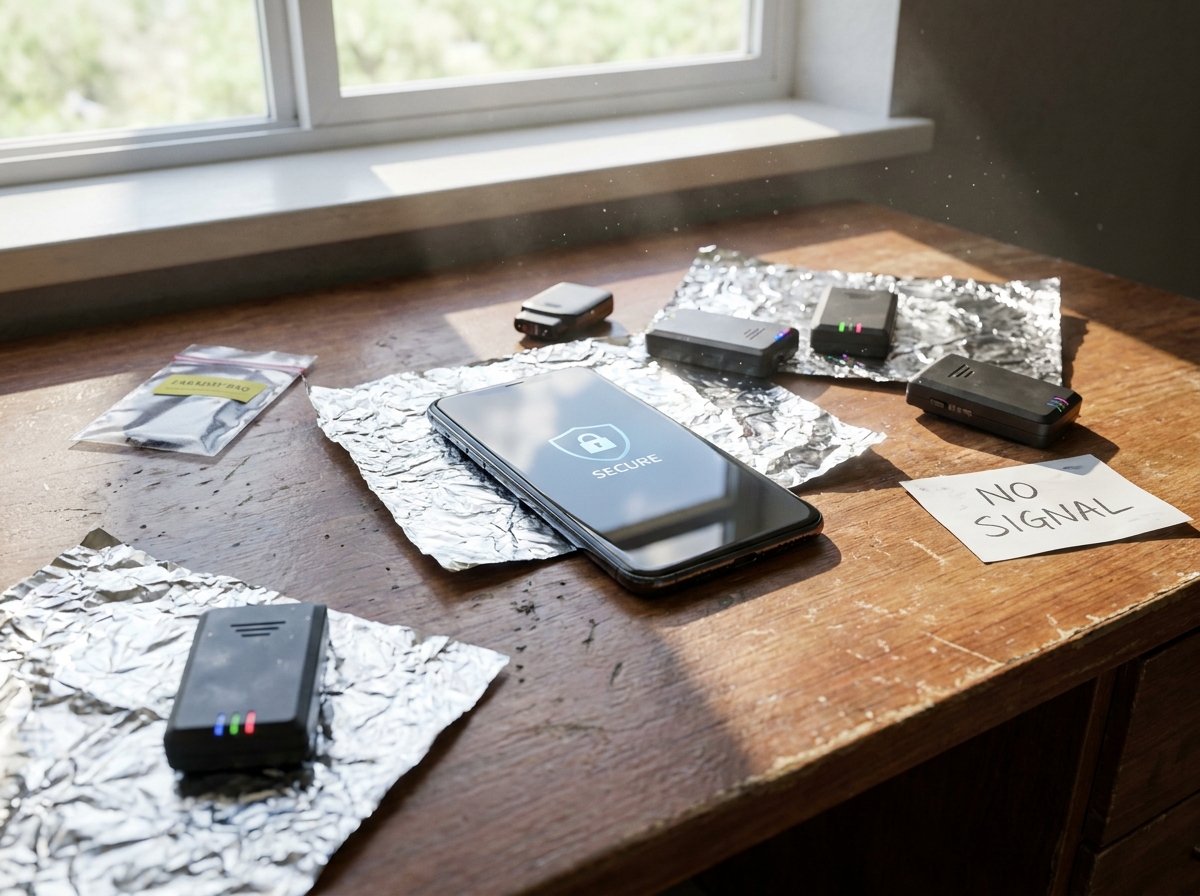
Airplane mode does not cut everything off. On most recent smartphones, residual emissions persist after activating airplane mode, particularly through NFC chips, UWB beacons, or certain system services that maintain low-range radio activity. A sensitive RF detector picks up these signals, even when the screen is black and the user thinks their device is silent.
Residual emissions in airplane mode: what RF detectors still pick up
We frequently observe confusion in the field between “airplane mode activated” and “no radio emissions.” Airplane mode disables cellular connections, Wi-Fi, and Bluetooth visible in the settings. It does not guarantee the shutdown of all chips.
The NFC chip often remains active by default on Android, even in airplane mode. On certain Samsung and Pixel models, it must be manually disabled in the connection settings. The UWB (Ultra-Wideband) technology, present on high-end smartphones for several generations, operates independently of airplane mode on certain firmware.
A wideband frequency detector typically scans from a few MHz to several GHz. An NFC chip emits at 13.56 MHz, Bluetooth Low Energy around 2.4 GHz, and UWB between 6 and 8 GHz. Even a single active chip is enough to betray the presence of a device.
For those looking for tips to jam a phone detector on Techronix, the first step is to understand which radios remain active on their specific model before considering any physical countermeasures.
Portable Faraday cage: electromagnetic isolation of the smartphone
The only reliable method to eliminate all radio emissions from a phone without destroying it involves complete electromagnetic isolation. Faraday pouches and cases block waves by surrounding the device with a continuous conductive mesh.
Not all pouches are created equal. Effectiveness depends on the quality of the shielding, the closure (a poorly fitted flap allows the signal to leak), and the frequency band attenuated. We recommend checking three criteria before any purchase:
- The stated attenuation covers at least the range 700 MHz – 6 GHz, which includes cellular bands, Wi-Fi, Bluetooth, and NFC
- The closure is a wrap-around flap or roll, without seams or gaps on the edges, as a few millimeters of opening are enough to let a very short-range NFC signal through
- The product has been tested by an independent laboratory or presents a measured attenuation report in dB, not just a marketing mention of “anti-RFID”
A simple aluminum foil wrapped around the phone works in theory, but in practice, the folds create discontinuities that allow certain frequencies to leak. A dedicated Faraday pouch is far more reliable than a homemade solution.
Connected accessories and objects revealing the presence of a smartphone
Making the phone invisible is not enough if a connected accessory continues to emit nearby. Smartwatches, Bluetooth headphones, and trackers like AirTag or SmartTag maintain active connections even when the main smartphone is isolated or turned off.
A connected bracelet in phone-finding mode emits Bluetooth Low Energy requests at regular intervals. An RF detector picks up these emissions and infers the probable presence of a smartphone nearby, even if it is in a Faraday pouch.
Protocols to disable on accessories
Turning off the phone and slipping it into a shielded pouch while keeping a smartwatch on the wrist nullifies the effort. We recommend turning off Bluetooth directly on each worn accessory, not just on the phone. On most watches running Wear OS, Bluetooth can be manually disabled in the watch’s connectivity settings.
Wireless earbuds are often the most forgotten: stored in their open case, they continue to emit a pairing signal. Closing the case generally cuts off the emission, but some models maintain a location signal.
Next-generation detectors: cameras and software supervision in professional environments
Anti-smartphone controls in companies, exam rooms, or certain sensitive sites no longer rely solely on RF scanners. Supervision systems now combine cameras, access sensors, and software analysis.
A camera paired with an object recognition algorithm detects the characteristic rectangular shape of a phone, even in a jacket pocket. In this scenario, no radio trick works: the phone is detected visually, not electromagnetically.
Adaptation strategies based on detection type
Before choosing a method, it is essential to identify the type of detector in place:
- Against a portable RF scanner, Faraday isolation or complete shutdown (removable battery removed) are effective
- Against a millimeter wave gate (like airport security), the mass and density of the phone are detected, not its radio emissions, so the Faraday pouch is useless
- Against a video surveillance system with AI object detection, only the physical absence of the phone guarantees invisibility
The most realistic countermeasure in a multi-layer detection environment remains to leave the phone out of the controlled area. Trying to conceal it by combining a shielded pouch and physical camouflage increases the risk of detection by either system and exposes one to much harsher penalties than a simple temporary confiscation.
Each detection situation calls for a different response. Precisely identifying the technology used in the relevant environment before choosing an isolation method avoids ending up with an expensive Faraday pouch against a simple metal mass gate, or conversely, with a turned-off phone but with a watch on the wrist emitting a Bluetooth signal picked up in seconds.